
- All Posts
- From Concept to Commissioning: Why Modular Productization Is Critical to Speed-to-Market in the Data Economy
From Concept to Commissioning: Why Modular Productization Is Critical to Speed-to-Market in the Data Economy
Rapid growth in data consumption, and the compute infrastructure required to support it, has pushed project delivery expectations to new limits. Conventional, field-built approaches struggle to match these timelines, especially as systems increase in scale and complexity. Modularization addresses these constraints by moving critical scopes into controlled environments where quality, schedule, and cost are far more manageable.
The pressure is systemic. Every industry — from AI development to cloud computing to connected logistics — relies on data infrastructure that’s expanding faster than traditional construction can deliver. Yet conventional, field-based methods are dependent on coordination across dozens of subcontractors, materials arriving in sequence and weather-dependent schedules. In a landscape where uptime, power availability, and performance dictate value, this much uncertainty is no longer acceptable.
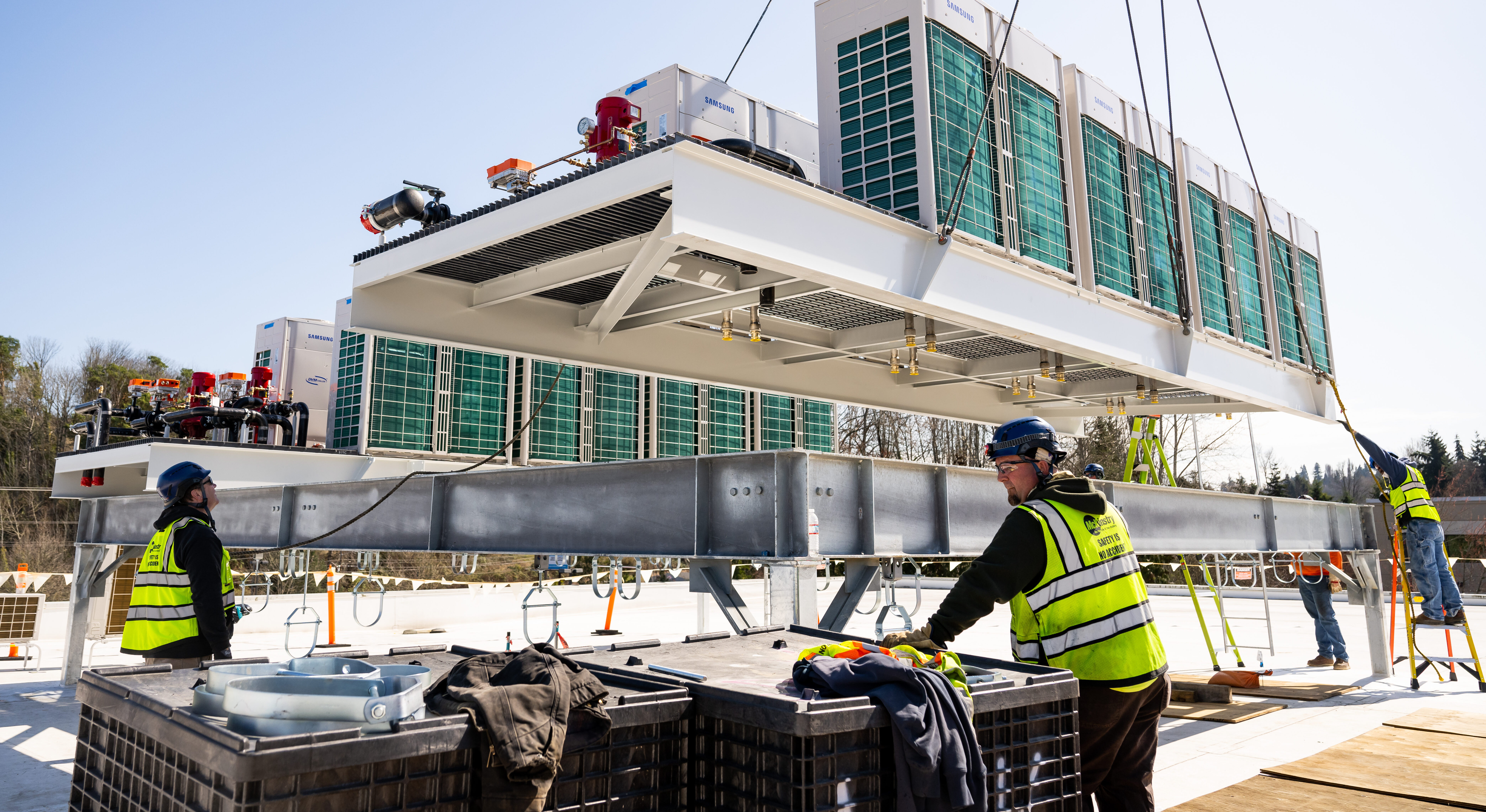
Modularization fundamentally changes the equation. By shifting the most complex parts of construction into controlled manufacturing environments, teams eliminate many of the variables that delay and derail projects. Systems are built, tested, and validated before they ever reach the job site, turning installation into an efficient assembly process rather than ground-up construction.
At McKinstry, modularization is integrated from the earliest concept stages through final commissioning. Our teams align design, detailing, fabrication, and installation under a unified approach, closing the gap between engineering intent and field execution. This manufacturing-driven model reduces rework, tightens schedules, and gives clients confidence that what’s designed is exactly what will be delivered.
Beyond speed, modularization gives owners greater control. Standardized materials steady the impact of supply chain volatility. Workstreams run in parallel, easing labor constraints and accelerating critical path activities. For data centers, health care, and life sciences, where uptime reliability define value, these gains are transformative.
There is also a measurable sustainability benefit. Controlled manufacturing environments generate significantly less waste, reduce on-site energy use, and enable more deliberate material utilization. As organizations pursue embodied carbon reductions, the environmental accountability built into modular delivery becomes a meaningful differentiator. Modularization doesn’t just accelerate construction; it builds accountability into every step of the process.
The lesson is simple but significant: industrialized construction isn’t the future of project delivery — it’s the present requirement for those operating at the edge of performance. The firms that thrive in the data economy will be those that design for manufacturability, plan for assembly and commission with confidence.
McKinstry’s work in modular delivery demonstrates that building faster doesn’t require sacrificing quality. It requires redefining how quality is achieved. From concept to commissioning, modularization transforms construction from a sequence of risks into a system of reliability—and in a data-driven world, reliability is the ultimate competitive edge.
Explore other Insights
From Concept to Commissioning: Why Modular Productization…
Rapid growth in data consumption, and the compute infrastructure required to support it, has pushed project delivery …

AI’s Shadow Footprint: What Smart Infrastructure Needs to…
Every advancement in artificial intelligence carries a physical consequence: more computation, more heat and more pow…
Designing for an Energy-Constrained Future: Four Forces R…
The world’s demand for artificial intelligence is accelerating faster than any other technological cycle in modern hi…

