
- All Posts
- AI’s Shadow Footprint: What Smart Infrastructure Needs to Look Like in an AI-Powered World
AI’s Shadow Footprint: What Smart Infrastructure Needs to Look Like in an AI-Powered World
Every advancement in artificial intelligence carries a physical consequence: more computation, more heat and more power demand. What once existed as invisible “cloud infrastructure” is now physical – drawing power, producing heat and reshaping how we build. As technology expands, the real question isn’t how much we can construct to support it, but whether we can do so responsibly, efficiently and at scale. With this new era, infrastructure must evolve to anticipate change, self-optimize and maintain performance as computational loads grow exponentially.
AI is redefining the standards of infrastructure performance. The next generation of infrastructure must deliver speed, accuracy and resilience simultaneously. Design must move beyond efficiency toward orchestration — integrating mechanical, electrical and digital systems into unified, repeatable frameworks. The ability to scale without compromise will define leadership in this new landscape.
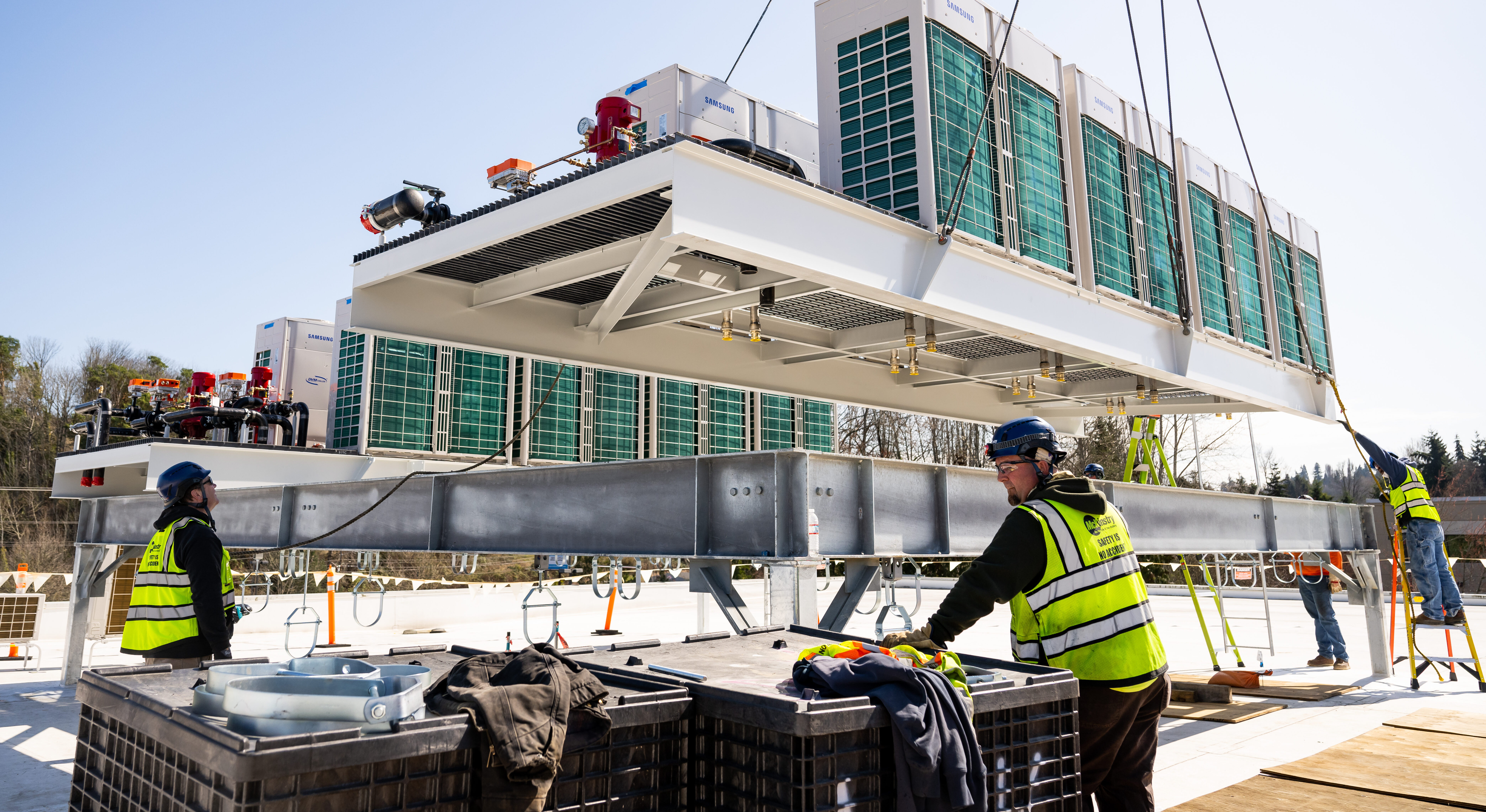
Traditional construction can’t keep pace with the precision and speed that modern computational workloads demand. Offsite manufacturing transforms complexity into predictability, moving risk and labor from the field into controlled environments. Enabling fabrication, logistics and installation to proceed in parallel compresses timelines and ensures quality long before equipment reaches the site. The result is infrastructure that’s not only faster to deploy but inherently more reliable and measurable in performance.
The growing appetite for power outpaces the capacity of utilities to keep up. Designing for artificial intelligence means designing for scarcity. Integrating energy systems directly into offsite-built modules through heat reuse, renewable tie-ins and direct-current distribution creates efficiency at the source. This transforms data centers and industrial facilities from high-consumption assets into active contributors within local energy ecosystems. The next era of efficiency isn’t about stretching resources thinner but about designing systems that waste nothing — precision where waste once lived.
The next generation of smart infrastructure will be intelligent by default. Factory-built assemblies enable sensors, digital twins and predictive controls to be calibrated before deployment. This allows real-time optimization of performance, anticipating energy spikes, balancing thermal loads and ensuring uptime. Intelligence must live in the infrastructure layer itself, where physical performance and digital insight converge.
AI may represent the most advanced digital intelligence in human history, but it’s nothing without a physical foundation built to match its complexity. The next frontier lies in the infrastructure that allows data centers to exist at scale. The grid, the building and the algorithm are now part of the same ecosystem, demanding that we design with interdependence in mind. Every watt consumed, every molecule of heat released and every second of uptime now forms the real architecture of intelligence.
This is where the industry’s role evolves from building to enabling. Smart infrastructure must not only host AI but think like it: adaptive, predictive and efficient by design. The future of intelligence is constructed, welded and wired in the built environment. And that’s where McKinstry operates; at the intersection of physical precision and digital potential, designing infrastructure that doesn’t just support intelligence but amplifies it.
Explore other Insights
From Concept to Commissioning: Why Modular Productization…
Rapid growth in data consumption, and the compute infrastructure required to support it, has pushed project delivery …

AI’s Shadow Footprint: What Smart Infrastructure Needs to…
Every advancement in artificial intelligence carries a physical consequence: more computation, more heat and more pow…
Designing for an Energy-Constrained Future: Four Forces R…
The world’s demand for artificial intelligence is accelerating faster than any other technological cycle in modern hi…

