
- All Posts
- Designing for Density: How to Maximize Cooling, Power and Performance in High-Demand Environments
Designing for Density: How to Maximize Cooling, Power and Performance in High-Demand Environments
The electrical environment around us is becoming increasingly high-demand. From AI to electrified transportation to connected manufacturing, nearly every sector is drawing more power, more consistently. Data infrastructure sits at the center of this transformation. As servers and systems push the limits of what power and cooling networks were built to handle, the imperative is clear: design with peak load in mind. Every decision now shapes how effectively energy is produced, distributed and used. Efficient utilization grows more critical by the day.
Power and cooling can no longer be designed in isolation. The higher the rack density, the more interdependent electrical and mechanical systems become. Designing for density means anticipating energy and thermal convergence, not reacting to it after deployment. Cooling and electrical strategies must evolve together to support high-density environments efficiently. Integrated planning is the difference between systems that adapt and systems that fail under pressure.
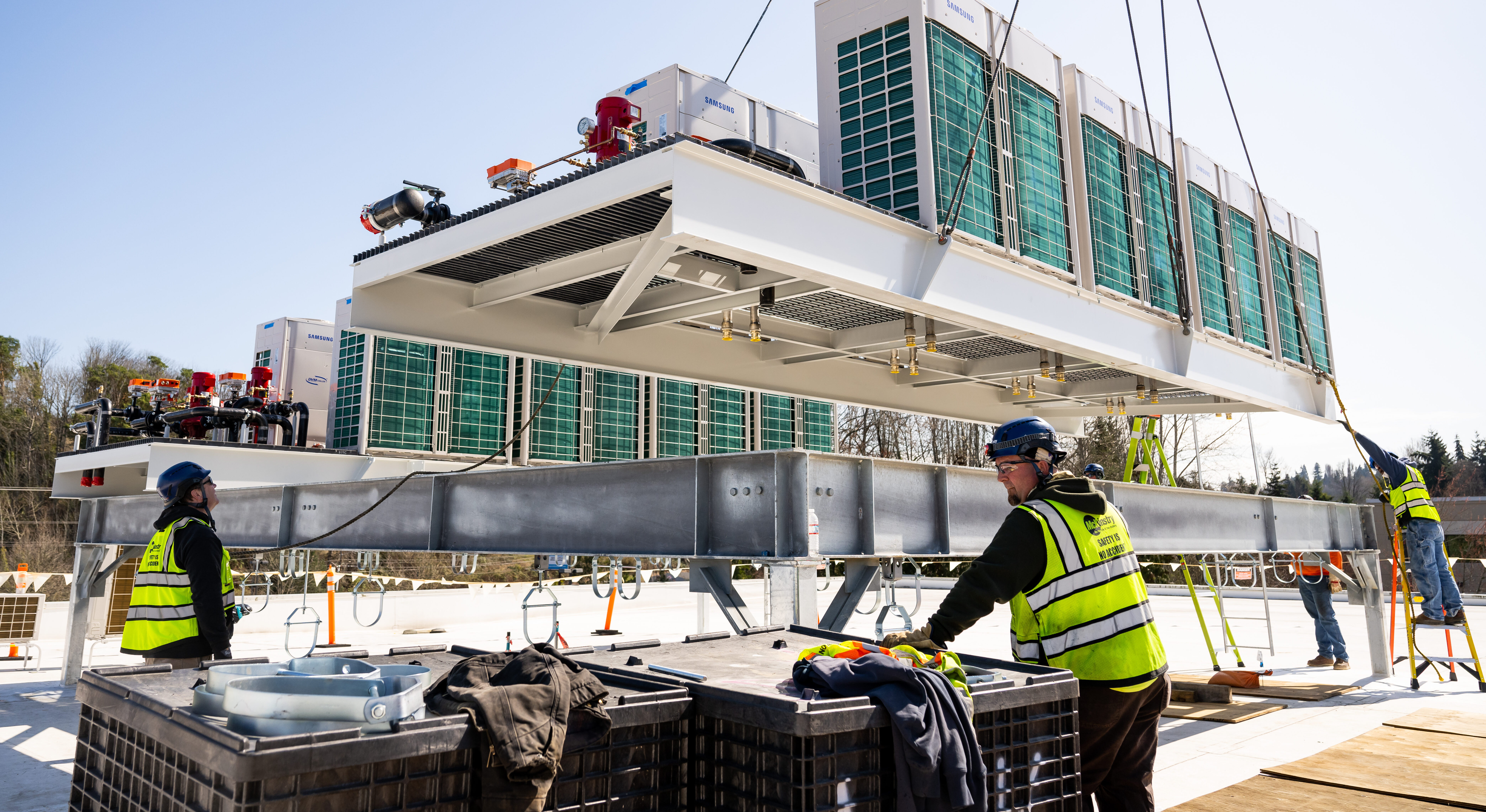
Traditional construction can’t keep pace with demand. The path forward lies in integration of design, fabrication and logistics from day one. Off-site manufacturing enables prefabricated, high-precision assemblies that reduce risk and accelerate deployment. Coordinated logistics ensure modules arrive in sequence and ready for installation, compressing timelines by as much as 30-50% in certain applications. Integration isn’t just efficiency – it is risk management that supports reliability at scale.
Every kilowatt consumed and cooled impacts performance and sustainability outcomes. In dense environments, performance gains depend on how intelligently power is delivered, cooled and recovered. Advanced liquid cooling and heat recovery systems can convert thermal output into usable energy, where site and system conditions allow – reducing operational costs and easing grid strain. Treat energy as a recoverable loop, not a one-way expense.
Density targets will continue to rise as AI, automation and electrification expand. Infrastructure must be designed to adapt just as quickly. Modular electrical rooms, scalable power distribution and adaptive cooling systems make it possible to expand capacity without major redesigns. Flexible infrastructure design is key to maintaining performance under rapid change. McKinstry’s integrated delivery model connects design, manufacturing and field execution to give clients the agility they need to scale with confidence. Future-ready infrastructure isn’t static. It is built to evolve alongside demand.
Designing for density isn’t about reacting to rising power. It is about reengineering how infrastructure and intelligence converge. The future belongs to systems that think ahead, adapt in real time and extract more value from every watt that flows through them. The next generation of facilities is poised to merge digital precision with industrial resilience, where every component — electrical, mechanical and computational — operates as a synchronized network. This is where performance and sustainability stop competing and start reinforcing one another.
McKinstry’s vision is to make that convergence possible. By uniting design, manufacturing and operational intelligence, we help clients turn density from a challenge into an advantage. The result isn’t just more capacity. It is smarter capacity — infrastructure that performs harder, lasts longer and sets the benchmark for what modern energy systems should be.
Explore other Insights
From Concept to Commissioning: Why Modular Productization…
Rapid growth in data consumption, and the compute infrastructure required to support it, has pushed project delivery …

AI’s Shadow Footprint: What Smart Infrastructure Needs to…
Every advancement in artificial intelligence carries a physical consequence: more computation, more heat and more pow…
Designing for an Energy-Constrained Future: Four Forces R…
The world’s demand for artificial intelligence is accelerating faster than any other technological cycle in modern hi…

