
Sustainability Meets Revenue: Helping Clients Turn Environmental Challenges into Opportunity

Growing up, McKinstry Energy Project Director Erik Budsberg spent every available moment climbing or hiking. So, when it came time to pick his major, he naturally chose the one that would get him as close to the mountains as possible: geology.
“I thought it would be a good way to be outside and around a bunch of people who want to do the same thing,” said Erik. “But then I really got into it. It turns out that I really like science and I dove into the whole world of geology.”
What Erik was learning about the Earth and its resources started to intersect with what he observed about the human landscape as he traveled the I-5 corridor looking for his next climb or ski.
“You’re driving through community after community, and you see the same buildings over and over — the big box stores, grocery stores and warehouses,” said Erik. “This put to scale for me how big we are collectively as a society and the impact we have on the environment. Resources and how we use them are really important now and for the future.”
An internship with a natural gas company only fueled his thoughts and imagination further.
“That exposure to the oil and gas industry changed my perspective on what it takes to find energy, how we use energy, and just the sheer quantities of energy that society needs to operate,” said Erik. “I saw the need for energy resources, but I also wanted to look at new ways to make these resources. Are we completely stuck with fossil fuels or are there opportunities to bridge some of the gaps with more bio-based products?” he wondered.
Erik took his question to the University of Washington where he found his answer in his pursuit of master’s and doctoral degrees in environmental science and studies in biofuels and carbon capture. He came to the hopeful conclusion that not only can bio-based fuels help reduce reliance on fossil natural gas and reduce environmental impacts of CO2, but they can also be engines of revenue, generating substantial economic benefits for those who make and use them.
Taking Carbon Management to the Next Level
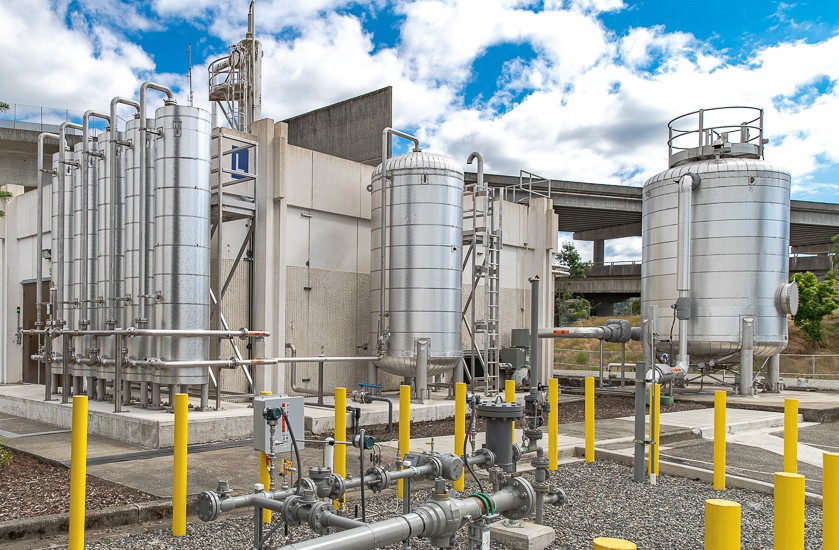
McKinstry has two new RNG projects underway in Eastern Washington to install renewable natural gas processing systems at water reclamation facilities.
“RNG is exciting because it turns an existing waste stream into multiple sources of value. At wastewater treatment facilities, organic materials are already being broken down through anaerobic digestion, producing biogas that’s mostly methane. Historically, that gas has been flared or only partially used on site,” said Erik. “This biogas can be cleaned and upgraded to pipeline quality natural gas, a renewable fuel that reduces greenhouse gas emissions, improves energy resilience, and creates entirely new revenue streams for the owner, often a city or county.”
Erik joined McKinstry from Eastern Washington University, where he served as director of utilities and sustainability for a decade. He’s now using his expertise to move RNG projects in development along, while also scouting for additional opportunities.
“Recognizing the emergence and growing market acceptance of carbon management as a critical strategy for reducing greenhouse gas emissions, we saw a clear need to strengthen McKinstry’s expertise in this space,” shared Erik’s manager Christie Hoffpauer, regional director, Energy Spokane. “Erik brings a unique ability to turn ambitious sustainability goals into practical, achievable solutions. He understands what’s financially and technologically feasible and helps teams move forward with confidence and clarity.”
While advising on the renewable natural gas market and technologies for McKinstry, Erik is also focusing his attention on carbon capture, an emerging space with future opportunity. In the literal sense, carbon capture is exactly what the name implies: capturing carbon emissions at the source to prevent greenhouse gas emissions. Emissions are either sent to permanent storage or, less commonly, processed as a renewable resource, such as synthetic fuels, cement or other building materials.
Currently, carbon capture is primarily used at large, fixed industrial sources such as natural gas processing plants where emissions are sent for sequestration, or storage.
“I’m evaluating the carbon capture technology to see how that industry is shaping up, what the opportunities are going to be for us for business in the future, and what’s the right equipment for our clients to use,” said Erik.
One of the most exciting pathways Erik sees for this technology is bioenergy with carbon capture and storage. It uses sustainable biomass, such as forestry and agricultural residues, to generate energy. The resulting emissions are then captured and stored.
“This creates a carbon negative outcome, which is really exciting,” said Erik. “As companies like Microsoft and Amazon pursue aggressive climate targets, the demand and market for these solutions is growing rapidly.”


Explore Other Insights
Helping Washington Building Owners Meet the Moment: Early…
Across Washington, building owners aren’t waiting for the Clean Buildings Performance Standard (CBPS) deadlines to st…

Nicole Cook: Leveraging Skills to Create a Lasting Impact
For Nicole Cook, program manager for Technical Services, true success looks like creating environments that not only …
How Do You Cool a Data Center Built for AI? McKinstry’s S…
Over 20 years at McKinstry, Seth Davis has built an engineering career shaped by complex systems, large-scale project…

